Phonics
Best CVC Word Worksheets for Kindergarten: Free vs Paid, and What to Look For
This guide is for parents. It may contain affiliate links and mentions our own workbook; if you buy through them we may earn money at no extra cost to you. We have not hands-on tested the paid programs below unless we say so; we compare them from their published information. Details.
CVC words (consonant-vowel-consonant words like cat, sun and pig) are usually where a kindergartner first reads real words. Search "CVC worksheets" and you'll find thousands of pages. Many are fine. Some quietly make reading harder: confusing pictures, words that don't follow the pattern, or no clear order.
This guide is for parents choosing CVC practice pages. We explain what to look for (with the kindergarten standards behind it), compare free and paid options with real prices, and show how to use the pages well. We haven't reviewed every worksheet site out there; instead we give you a checklist you can apply to any page in about thirty seconds.
Where CVC words fit in kindergarten
Two kindergarten foundational skills in the Common Core standards are about exactly this (Common Core RF.K):
- RF.K.2.d: isolate and pronounce the first, middle (vowel) and last sounds in three-sound CVC words. The standard notes this doesn't include CVC words ending in /l/, /r/ or /x/.
- RF.K.3.b: link the short and long sounds with the common spellings for the five major vowels.
Before CVC worksheets make sense, a child should know most consonant sounds (RF.K.3.a) and be starting to blend sounds aloud. If blending isn't there yet, start with our step-by-step guide to teaching a 5-year-old to blend sounds.
The 7-point checklist for a good CVC worksheet
1. Every picture has one obvious name. If the picture could be "cup" or "mug", "rug" or "mat", "hen" or "chicken", your child can do everything right and still "get it wrong". This is the most common problem with CVC pages, and it matters more than cute graphics.
2. The words really are simple CVC words. Each letter should make its most common sound: cat, hop, sun. Watch for words like car (r-controlled vowel), saw or few, which look short but don't follow the CVC pattern. Following the standard's note, many teachers also leave words ending in l, r or x out of early CVC practice.
3. Short vowels are introduced in a sensible order. Pages that mix all five vowels from day one are hard for beginners. Look for single-vowel pages (all short a) before mixed pages. Many programs, including Explode the Code Book 1, introduce the short vowels one at a time (Christianbook product description).
4. There's both reading and spelling. The best sets include decoding (read the word, find the picture) and encoding (see the picture, write the missing vowel or the whole word). The K–3 practice guide from the U.S. Department of Education recommends teaching children to decode words and to write them (IES practice guide, Foundational Skills K–3).
5. Big, clear print and few items per page. Five-year-olds do better with 6–8 items than 20. White space makes pages less intimidating, and saves ink.
6. An answer key. It sounds minor until you're checking work while making dinner. An answer key means you can check a page together in seconds and correct mistakes immediately.
7. It leads somewhere. Good sets progress from CVC words to word families, short sentences, and then digraphs (sh, ch, th) and blends (st, fl). Random one-off pages don't.
Free vs paid: what you actually get
| Option | Cost | Strengths | Watch out for |
|---|---|---|---|
| Free worksheet sites and blogs | $0 | Endless variety; good for filling gaps | Mixed quality; ambiguous pictures; rarely in sequence; often no answer key |
| Printables included in an app subscription | Part of the subscription | Matched to the app's lessons | Only worth it if you use the app. Reading Eggs lists 716 printable worksheets with its reading programs at $13.99/month or $99.99/year (Reading Eggs pricing) |
| Explode the Code Book 1 (workbook) | $10.09 (School Specialty) | 96 pages focused on short vowels and CVC words, with a pretest and posttest | Consumable (one per child); listed for grades 1–3; assumes consonant sounds are known |
| Curriculum activity books (e.g. All About Reading) | Part of the curriculum; Level 1 Materials $159.95 (AALP) | Pages tied to scripted lessons | Expensive if you only want practice pages |
| Printable workbooks from independent sellers | Varies | Print as many copies as your license allows; often include answer keys | Quality varies; check samples first |
Our take: free pages are fine if you apply the checklist. The case for paying is sequence (pages in a sensible order), clear pictures and an answer key, which together save you time every day.
How to use CVC worksheets well (10 minutes a day)
- Warm up aloud (2 minutes). Say three words in robot talk ("/p/ /i/ /g/") and have your child blend them. Then reverse: you say "pig", they say the sounds.
- One worksheet page (5 minutes). Sit nearby for the first few items. Ask your child to say each word aloud, not just circle.
- Check together immediately (2 minutes). Use the answer key. For any mistake, ask "Can you read it again, sound by sound?"
- Read one decodable sentence (1 minute). "The pig sat in the mud." The IES guide recommends that children read connected text every day (IES practice guide).
Keep a done pile. Re-doing an old page a week later is great review, especially with a sheet protector and a dry-erase marker.
Red flags: skip pages like these
- Pictures that need explaining ("it's a tub, not a bath").
- More than about a dozen items on one page for a five-year-old.
- Sight words mixed in as if they could be sounded out.
- Cursive or decorative fonts where the letter shapes differ from what your child is learning.
- Pages that only ask a child to color, with no reading or writing.
A sensible order for CVC practice
| Week (approx.) | Focus | Example words |
|---|---|---|
| 1–2 | Short a | cat, map, sad, nap |
| 3 | Short i | pig, sit, fin, lid |
| 4 | Short o | dog, hop, pot, log |
| 5 | Short u | sun, bug, cup, mud |
| 6 | Short e | hen, bed, net, pet |
| 7+ | Mixed vowels, word families, short sentences | cat/cot/cut, -at/-ig/-op families |
The weeks are only a rough guide. Move on when your child reads that vowel's words easily, and slow down if not. (e comes last here because many children confuse short e and short i.)
Our workbook's CVC pages
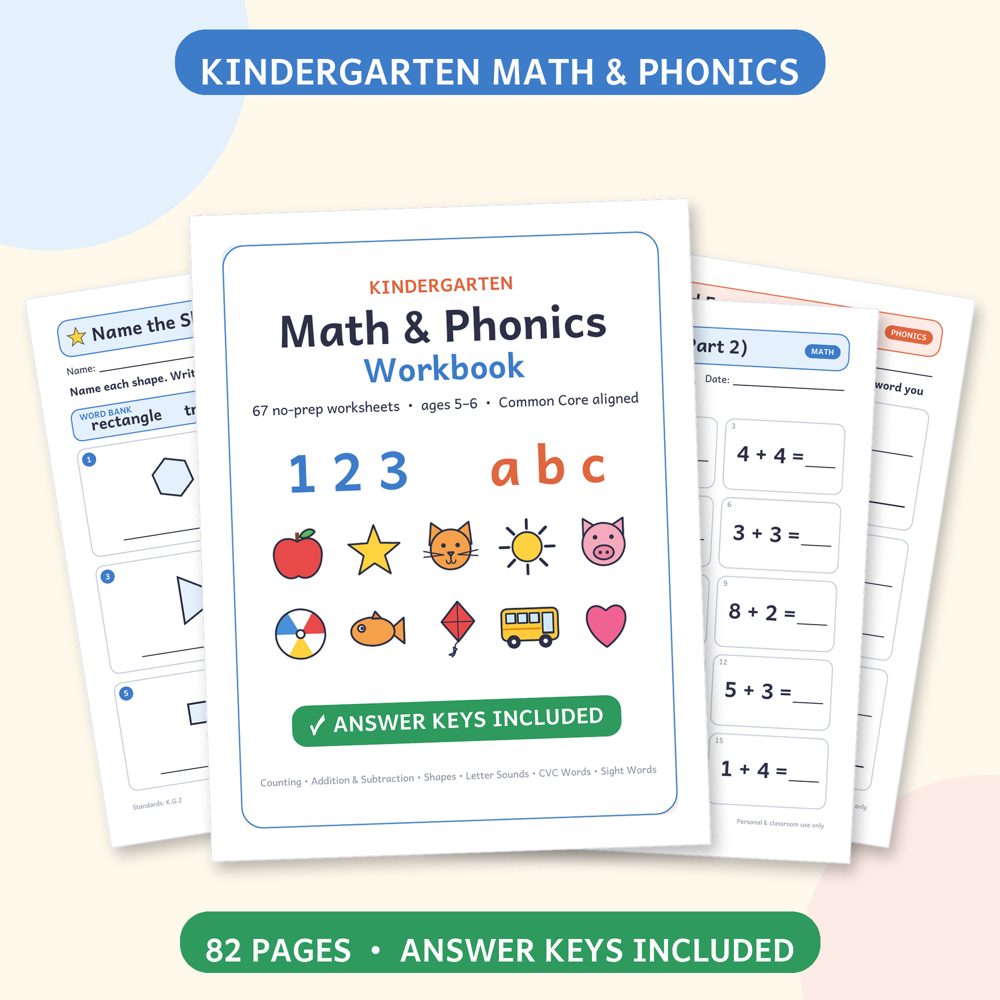
We sell a printable kindergarten workbook built around this checklist: phonics pictures were chosen so each has a single clear answer, and there's an answer key for every non-tracing page. Its phonics section moves through beginning and ending sounds, missing short vowels (3 pages), read and match CVC words (2 pages), read the word and find the picture, word families, rhyming, sight words, digraphs and blends.
You can try two of the CVC pages free in our sample pack.
From our own shop
Kindergarten Math & Phonics Workbook
82 printable pages: 67 no-prep worksheets (38 math, 29 phonics) plus a 9-page answer key, aligned to Common Core Kindergarten. $7.99, instant PDF (US Letter and A4).
See what's inside Get 4 free sample pages
We make and sell this workbook, so we have a financial interest. It was made with the help of AI tools; see the product page for details.
FAQ
At what age should kids do CVC worksheets? CVC decoding is part of the kindergarten standards, so most children meet it around ages 5–6. Readiness matters more than age: start once your child knows most letter sounds and can blend three sounds aloud.
Should CVC words include sight words? Keep them separate at first. Sight words like the and is are learned by memory (RF.K.3.c); CVC words are sounded out. Mixing them too early can encourage guessing.
My child can read CVC words on worksheets but not in books. Common. Add daily decodable text and re-read the same short book several days in a row.
Prices checked October 2026. Some product names may become affiliate links later; we may earn a commission at no extra cost to you.