Phonics
How to Teach a 5-Year-Old to Blend Sounds (Step by Step, With Printables)
This guide is for parents. It may contain affiliate links and mentions our own workbook; if you buy through them we may earn money at no extra cost to you. We have not hands-on tested the paid programs below unless we say so; we compare them from their published information. Details.
Your child knows that m says /m/, a says /a/ and t says /t/, but put them together as "mat" and you get a blank look, or "m… a… t… tam?" Blending is the step where phonics turns into reading, and for many five-year-olds it's the hardest one. The good news: it's a skill you can teach in small, daily steps.
This guide is for parents. It draws on public research summaries (linked) rather than our own testing, and it's practical: what to do, in what order, with what materials.
Why blending matters (and why it's hard)
The National Reading Panel found that teaching children to hear and manipulate the sounds in words (phonemic awareness) had a moderate effect on reading outcomes (effect size 0.53), and that instruction which used letters helped children more than sound work alone (National Reading Panel report, NICHD). The same report found larger effects when instruction focused explicitly on one or two sound skills at a time rather than three or more.
The U.S. Department of Education's K–3 practice guide puts it simply: teach children to blend letter sounds from left to right within a word to produce a recognizable pronunciation (IES practice guide, Foundational Skills K–3; Vermont AOE summary of the guide).
Blending is hard because the child has to hold several sounds in memory, in order, and then "hear" a word they know. That's a lot for a five-year-old, which is why we start with no letters at all.
Before you start: quick readiness check
Blending letters into words goes much more smoothly if your child can already:
- Say the most common sound for most consonants (Common Core RF.K.3.a) and the short vowel sounds.
- Hear rhymes (cat/hat) (RF.K.2.a).
- Hear the first sound of a word ("What's the first sound in sun?") (RF.K.2.d).
Those are all kindergarten foundational skills (Common Core RF.K). If several are missing, spend a week or two on them first. Our phonics program guide has a 10-minute check.
Step 1: Oral blending with big chunks (no letters)
Start with compound words and syllables, which are easier to hear than single sounds. The Common Core kindergarten standards include blending and segmenting syllables (RF.K.2.b).
- "Cup… cake. What word?" → cupcake
- "Sun… shine." → sunshine
- "Ta… ble." → table
Play it as a guessing game: "I'm thinking of an animal: ti… ger."
Move on when your child gets these quickly.
Step 2: Onset and rime (still no letters)
Split one-syllable words into the first sound and the rest (RF.K.2.c):
- "/c/ … at" → cat
- "/s/ … un" → sun
- "/m/ … op" → mop
Robot talk works well: "I'm a robot. I say /d/ … og. What did I say?" Then let your child be the robot.
Step 3: Blend all three sounds aloud (still no letters)
Now separate every sound (RF.K.2.d):
- "/s/ /a/ /t/" → sat
- "/f/ /i/ /n/" → fin
Tips: - Start with continuous sounds you can stretch: /m/, /s/, /f/, /l/, /n/, /r/. "Mmmmaaaat" is easier to blend than "/b/ /a/ /t/", where the /b/ can't be stretched. - Keep "bouncy" sounds short and crisp: say /b/, not "buh". Extra "uh" sounds make "buh-a-tuh", which doesn't blend into bat. - Use a gesture: touch your shoulder, elbow and wrist for each sound, then slide your hand down your arm to "say it fast".
Step 4: Add letters (successive blending)
Once oral blending is easy, bring in letters. The research summary above found that working with letters helped more than sound work alone, so this is where the real gains happen.
Use successive blending, which many children find easier than saying all three sounds and then trying to join them:
- Point to the first letter: "/m/".
- Point to the second and blend immediately: "/ma/" (hold it: "mmmaaa").
- Add the last sound: "/mat/". Then: "Say it fast!" → mat.
Use letter tiles, magnetic letters or cards so you can swap one letter at a time: mat → sat → sit → sip → hip. Changing one sound at a time matches a kindergarten standard too: adding or substituting individual sounds to make new words (RF.K.2.e).
Start with short a (mat, sat, map, nap), then add short i, o, u, and finally e, which is easy to confuse with i.
Step 5: Read real CVC words on paper
Now move to printed CVC words (consonant-vowel-consonant, like cat and sun).
- Picture matching: read the word, then circle the matching picture.
- Missing vowel: look at the picture of a cat and write the missing vowel in c_t. This is the reverse of blending (segmenting) and strengthens it.
- Word families: -at (cat, hat, mat, sat). Keeping the ending fixed means only the first sound changes.
Our free sample pack includes two pages for exactly this stage: Missing Short Vowels and Read and Match CVC Words.
Step 6: Read connected text every day
The IES guide recommends that each student read connected text every day (IES practice guide). As soon as your child can blend a handful of CVC words, give them decodable sentences and books that use only the sounds they know: "The cat sat on a mat." Read the tricky words for them, or point to sight words they've learned.
How long should this take?
Every child is different, and we can't give you a reliable number of weeks. Some children click in days, others take months. The National Reading Panel's report noted that phonemic awareness programs totaling 5 to 18 hours produced larger effects than shorter or longer ones (NRP report). That's a reminder that a modest amount of focused, daily time adds up. Five to ten minutes a day is a sensible starting point for a five-year-old.
Common problems and fixes
| Problem | Likely cause | Try this |
|---|---|---|
| Says sounds correctly but guesses a different word | Not holding sounds in order | Go back to oral blending; use successive blending |
| Adds "uh" to every sound ("buh-a-tuh") | Bouncy sounds over-pronounced | Model clipped sounds; start with stretchy sounds like /m/, /s/ |
| Blends 2 sounds, drops the third | Memory load | Use word families (-at, -an) so only the first sound changes |
| Reads the word, then forgets it in the next sentence | Not yet automatic | Re-read the same decodable text several days running |
| Frustration, tears | Too hard, too long | Shorten to 3 minutes; drop back a step; end on success |
When to get help
If, after several weeks of short daily practice, your child still can't blend two or three sounds aloud, or can't hear rhymes or first sounds, talk to your pediatrician or school district about screening. The International Dyslexia Association recommends universal screening starting in kindergarten (IDA). Early support helps.
Materials that help
- Letter tiles or magnetic letters for building and swapping words. Many curricula include tiles; All About Reading sells a set for $25.95 (AALP).
- Decodable readers from the library or a phonics program.
- Short CVC practice pages with an answer key, for daily review.
If you want structured lessons rather than putting this together yourself, compare All About Reading and Explode the Code.
From our own shop
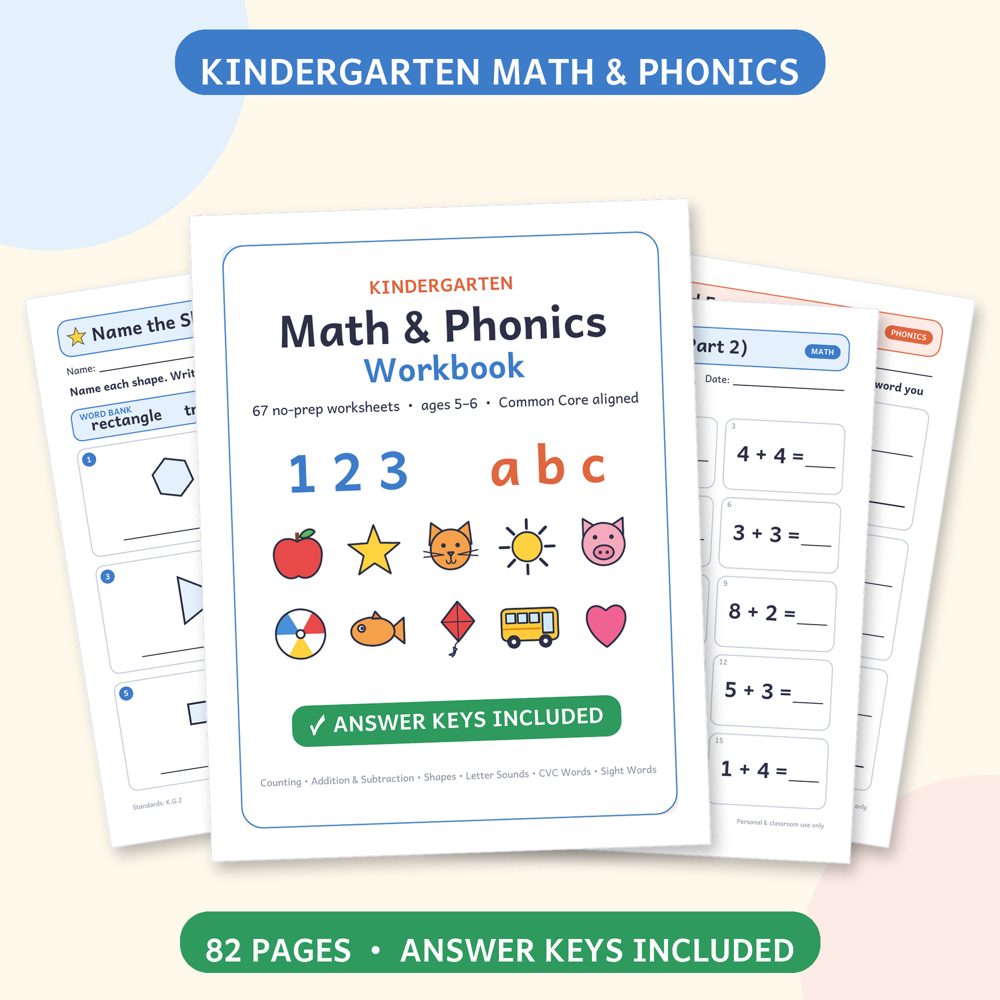
Kindergarten Math & Phonics Workbook
82 printable pages: 67 no-prep worksheets (38 math, 29 phonics) plus a 9-page answer key, aligned to Common Core Kindergarten. $7.99, instant PDF (US Letter and A4).
See what's inside Get 4 free sample pages
We make and sell this workbook, so we have a financial interest. It was made with the help of AI tools; see the product page for details.
Bottom line
Teach blending in small steps: big chunks aloud, then onset and rime, then three sounds aloud, then letters with successive blending, then CVC words on paper, then real sentences. Keep it short, daily and playful, and move on only when each step feels easy.