Phonics
Reading Eggs vs IXL for a 5-Year-Old: Which Is Worth Paying For?
This guide is for parents. It may contain affiliate links and mentions our own workbook; if you buy through them we may earn money at no extra cost to you. We have not hands-on tested the paid programs below unless we say so; we compare them from their published information. Details.
Reading Eggs and IXL both show up when you search for reading help for a kindergartner, but they're built differently. Reading Eggs is a game-style learn-to-read program. IXL is a large bank of practice questions. For most 5-year-olds that difference matters more than price.
We haven't used either with our own children for this article. This comparison is based on each company's published pricing and skill lists and on independent price summaries, all linked below. Check current prices before you subscribe.
Quick verdict
- Choose Reading Eggs if your 5-year-old is still learning to read and needs a guided path with lessons, songs, rewards and simple books. It also includes a math program and covers up to 4 children on one subscription.
- Choose IXL if your child is already reading a little and you want targeted practice on specific skills (for example short vowels or rhyming), or you want math and language arts practice that continues through later grades.
- Choose neither (yet) if your child is pre-reading and you'd rather keep screen time low. Start with short daily sound games, read-alouds and paper practice.
Price comparison
| Reading Eggs (home) | IXL (family) | |
|---|---|---|
| Monthly | $13.99 | $9.95 one subject; $15.95 math + language arts |
| Yearly | $99.99 | $79 one subject; $129 math + language arts |
| Extra children | Included: up to 4 children | About $4/month or $40/year per extra child |
| Math included? | Yes (Mathseeds) | Only with a math or combo plan |
| Trial/guarantee | 30-day free trial and 30-day money-back guarantee | Third-party summaries mention a 30-day money-back guarantee, and limited free practice without a subscription |
Sources: Reading Eggs pricing page; IXL figures from independent summaries by Brighterly (updated Aug 24, 2026) and The Pricer (June 2026). IXL's own family pricing page didn't display prices to our page fetch, so please confirm there.
What that means in practice:
- One child, reading only: IXL single subject ($79/year) is cheaper than Reading Eggs ($99.99/year).
- One child, reading + math: Reading Eggs ($99.99/year) is cheaper than IXL's combo ($129/year).
- Two or more young children: Reading Eggs covers up to four children on one plan; IXL adds a charge per extra child.
Reading Eggs also sells a separate "Homeschool Max" plan ($41.90/month or $299/year) with assigning, reporting and teacher-style tools (same pricing page). Most families with one kindergartner won't need it.
How each one teaches reading
Reading Eggs: a guided path
A Reading Eggs home plan includes four reading programs: Reading Eggs Junior (ages 2–4), Reading Eggs (ages 3–7), Fast Phonics (ages 5–10) and Reading Eggspress (ages 7–13). The company says Fast Phonics teaches "systematic, synthetic phonics," and lists 692 interactive lessons, 716 printable worksheets and 4,000+ books for the reading programs (Reading Eggs pricing page).
For a 5-year-old, the main draw is that it teaches: the child moves through lessons in order, with rewards along the way. That matches what the research recommends: phonics taught in a planned sequence. The National Reading Panel found systematic phonics instruction "significantly more effective than instruction that teaches little or no phonics" (NICHD, National Reading Panel findings).
The company's marketing also says children can "increase skills in 15 minutes a day." That's the company's claim; we haven't seen independent data behind that specific number.
IXL: targeted practice
IXL's kindergarten language arts list covers letter recognition, consonants and vowels, rhyming, syllables, sounds in words, short vowels and more, and its phonics page also lists digraph skills (IXL kindergarten language arts; IXL phonics). IXL also publishes how its kindergarten skills line up with Common Core standards (IXL K ELA alignment PDF).
IXL is mostly question-and-answer practice that adapts to your child. That works well when a child half-knows a skill and needs reps. It's weaker as the first place a struggling 5-year-old meets a new sound, because there's less step-by-step teaching than in a lesson-based program.
Side-by-side for a 5-year-old
| Question | Reading Eggs | IXL |
|---|---|---|
| Can it teach a non-reader from scratch? | Designed for that (ages 3–7 program plus Fast Phonics) | Better as practice once a skill has been introduced |
| Feels like | Games, characters, rewards | Practice questions with explanations and awards |
| Parent involvement | Lower during sessions; review reports after | Higher: you choose skills or follow recommendations |
| Printables | Yes, printable worksheets listed | Not the main focus |
| Grows with child | Through age 13 across its programs | Through later grades and more subjects |
| Screen time | Yes | Yes |
A note on screen time at 5
The American Academy of Pediatrics recommends that children 2 to 5 have no more than 1 hour per day of high-quality screen programming, ideally with a parent co-viewing and helping them apply what they learn (AAP, Media and Young Minds). If your 5-year-old already watches shows, adding a reading app may push past that. Many families handle this by swapping one show for one app session, or alternating app days and paper days.
What about paper practice?
Neither app replaces reading together. The K–3 practice guide from the U.S. Department of Education's What Works Clearinghouse recommends that each student read connected text every day (IES practice guide), so books still matter. Paper worksheets are a low-screen way to practise the same skills the apps cover: short vowels, CVC words, rhyming and sight words.
From our own shop
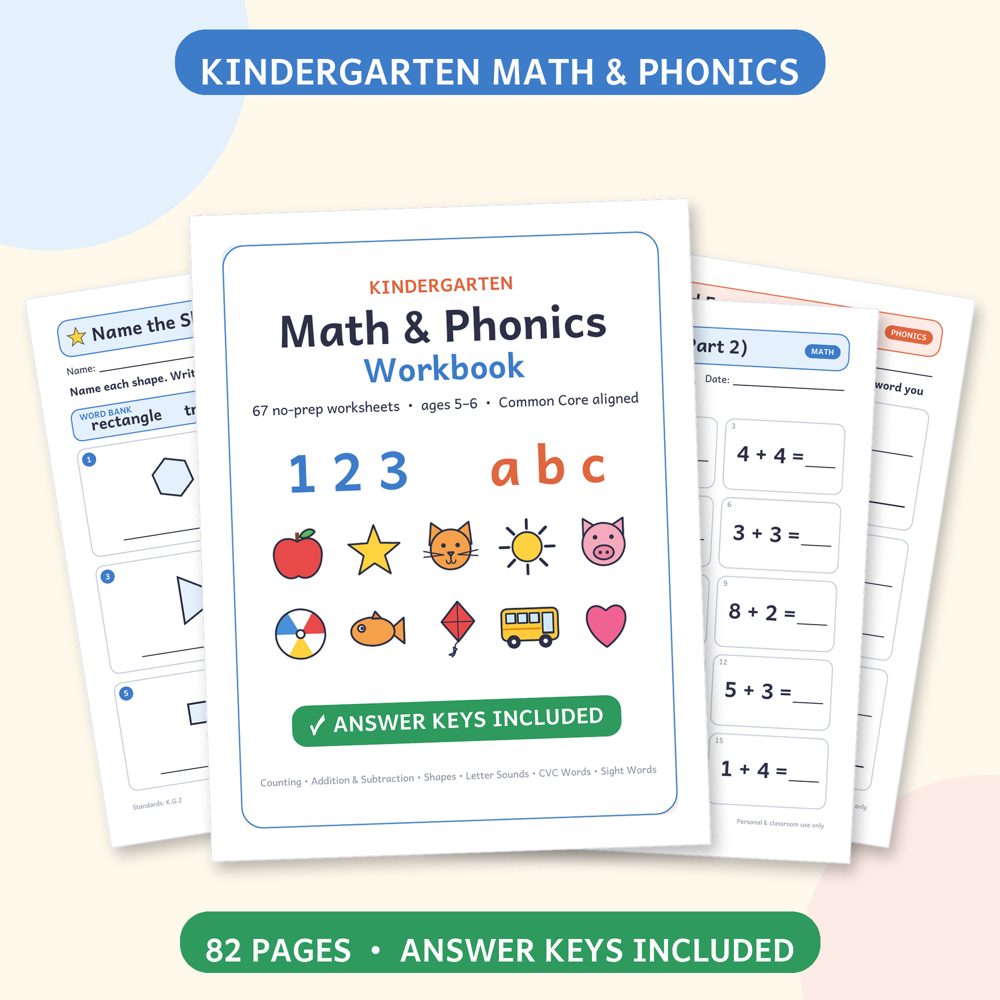
Kindergarten Math & Phonics Workbook
82 printable pages: 67 no-prep worksheets (38 math, 29 phonics) plus a 9-page answer key, aligned to Common Core Kindergarten. $7.99, instant PDF (US Letter and A4).
See what's inside Get 4 free sample pages
We make and sell this workbook, so we have a financial interest. It was made with the help of AI tools; see the product page for details.
How to run a fair trial before you pay for a year
Because Reading Eggs lists a 30-day free trial and both programs offer monthly billing, you can test before committing. A simple way to make the trial tell you something:
- Write down a starting point. Before day one, note which letter sounds your child knows and whether they can blend a few CVC words like cat, sit and hop. Use the same quick checks at the end.
- Keep sessions short and consistent. Pick a time (after breakfast, say) and stick to a short session most days, so you're testing the program, not your schedule.
- Sit in for the first few sessions. Watch whether your child is learning or just tapping to get rewards. Guessing through answers is a sign the level is too hard, or the format isn't working.
- Ask your child to show you off-screen. Can they read the words from the app on a sticky note or in a book? Transfer to paper and real books is the point.
- Set a calendar reminder a few days before the trial or first month ends, so you decide on purpose instead of auto-renewing.
If after a month your child is engaged and you can see new sounds or words showing up off-screen, the subscription is earning its keep. If not, a parent-led program plus paper practice may suit your child better, and that's a perfectly good outcome.
Our pick by situation
- Non-reader or very early reader, one or more siblings: Reading Eggs. It's lesson-based, covers up to 4 kids and includes math.
- Reading CVC words already and needs targeted practice: IXL Language Arts single subject.
- Wants math and reading for one child on a budget: Reading Eggs (reading + math for $99.99/year vs IXL's $129/year combo).
- Wants minimal screens: skip both for now; use a parent-led phonics program plus printable practice. See our guide to phonics programs for a kindergartner who's behind.
FAQ
Can I use both? You can, but it's usually overkill for a 5-year-old. If you do, use Reading Eggs for lessons and IXL to check specific skills.
Is either free? Reading Eggs lists a 30-day free trial. Independent summaries say IXL allows limited daily practice without a membership (Brighterly).
Do they align with kindergarten standards? IXL publishes Common Core alignment for kindergarten. Reading Eggs describes its Homeschool Max plan as curriculum-aligned (Reading Eggs pricing).
Prices checked October 2026. Affiliate links are placeholders until approved; we may earn a commission if you subscribe through them.