Phonics
Best Phonics Program for a Kindergartner Who's Behind (Homeschool Guide)
This guide is for parents. It may contain affiliate links and mentions our own workbook; if you buy through them we may earn money at no extra cost to you. We have not hands-on tested the paid programs below unless we say so; we compare them from their published information. Details.
If your kindergartner is struggling with letter sounds while friends are starting to read simple words, it's easy to panic-buy the first program you see. Slow down for ten minutes. The program matters less than three things: it teaches phonics systematically, you can do it a little every day, and it starts where your child actually is.
This guide covers what "systematic phonics" means and why it matters, how to find your child's real starting point, and five options at different prices. We haven't hands-on tested these programs. We compared them using their published prices, scope and sample materials, plus public research, and we link to everything.
Short answer
- You want a scripted, open-and-go program and can spend about $200: All About Reading (start with Pre-Reading if letter sounds are shaky, Level 1 if not).
- You want something cheap that a child can partly do alone: Explode the Code workbooks, paired with daily reading aloud together.
- Your child responds to games and you're OK with some screen time: Reading Eggs (and its Fast Phonics program) as practice alongside short daily lessons with you.
- You only need extra practice, not a full program: good printable worksheets with an answer key, used for 10 minutes a day.
What the research says to look for
Systematic phonics. The U.S. National Reading Panel reviewed the research and found that systematic phonics instruction "produces significant benefits for students in kindergarten through 6th grade and for children having difficulty learning to read" (NICHD summary of the National Reading Panel findings). "Systematic" means the program follows a planned sequence of letter-sound patterns instead of teaching them only when they happen to come up in a book.
Starting early is fine and helps. The Panel noted that the idea that kindergartners aren't ready for phonics "was not supported by the data" (same source). In the Panel's meta-analysis (66 comparisons from 38 experiments), the effect of phonics was larger when instruction began early (effect size d = 0.55) than after first grade (d = 0.27) (Ehri et al., Review of Educational Research, 2001).
Sounds first, then letters, then real reading. The U.S. Department of Education's What Works Clearinghouse practice guide for K–3 recommends building awareness of the sounds in spoken words and linking them to letters, teaching children to decode and write words, and having each child read connected text every day (IES practice guide, Foundational Skills to Support Reading for Understanding in K–3).
So for a child who's behind, a good program should:
- Teach letter-sound links in a clear order, with lots of review.
- Include oral sound games (rhyming, blending, breaking words into sounds), not just worksheets.
- Move quickly to reading real decodable words and short texts.
- Let you go slower without "falling behind" the program.
Step 1: find where your child really is
"Behind" can mean very different things. Before you buy anything, spend 10 minutes checking these, using the Common Core kindergarten foundational skills as a guide (Common Core RF.K standards):
| Check | What to ask your child | Kindergarten standard |
|---|---|---|
| Letter names | Point to random upper- and lowercase letters | RF.K.1.d |
| Rhyming | "Does cat rhyme with hat? Tell me a word that rhymes with sun." | RF.K.2.a |
| Sounds in words | "What's the first sound in map? The middle sound? The last?" | RF.K.2.d |
| Letter sounds | Point to consonants: "What sound does this make?" | RF.K.3.a |
| Blending | Say /c/ /a/ /t/ slowly: "What word is that?" | RF.K.2 |
| Sight words | Can they read the, to, is, my? | RF.K.3.c |
- Missing letter names, rhyming or first sounds? Start at the very beginning: a pre-reading level or an alphabet-and-sounds program.
- Knows most letter sounds but can't blend? Start at a beginning-reading level focused on blending CVC words (consonant-vowel-consonant, like cat, sun).
- Can blend CVC words slowly? Your child may not be "behind" so much as needing more practice and real reading every day.
Five options compared
Prices are from each seller's page when we checked in October 2026. They change, so confirm before you buy.
| Option | Type | Price we found | Best for |
|---|---|---|---|
| All About Reading (Pre-Reading or Level 1) | Scripted parent-led curriculum | Pre-Reading program $119.95; Level 1 Materials $159.95, plus Review Box $17.95 and Letter Tiles $25.95 (AALP price list, 07/21/2026) | Parents who want every lesson laid out |
| Explode the Code Book 1 | Consumable phonics workbook | $10.09 (School Specialty) | Tight budgets; extra short-vowel practice |
| Reading Eggs (includes Fast Phonics) | Online program/app | $13.99/month or $99.99/year, up to 4 children (Reading Eggs pricing) | Kids motivated by games; families with several kids |
| IXL Language Arts | Online practice | Third-party summaries list $9.95/month or $79/year for one subject (Brighterly, The Pricer); confirm on IXL's site | Targeted skill practice, not first teaching |
| Printable worksheets with answer keys | Paper practice | Varies; ours is $7.99 | Daily 10-minute review alongside a program |
All About Reading
All About Reading is a parent-led, scripted program. The Level 1 Materials package includes a teacher's manual, a student packet (activity book, flashcards, stickers) and three readers (All About Reading Level 1 page). The seller's page offers a 12-month return window (same page).
- Why it suits a child who's behind: lessons are already written, so you're not inventing a sequence, and the letter tiles give hands-on blending practice.
- Watch out for: cost, and the fact that it needs you sitting beside your child. It's not independent work. If letter sounds aren't solid, the publisher sells a separate Pre-Reading level.
Explode the Code
Explode the Code Book 1 is a 96-page consumable workbook that introduces short vowel sounds and blending CVC words. It includes a pretest that checks consonant sounds, which the book treats as a prerequisite (Christianbook product description). The listing describes it as grades 1–3, so for a kindergartner who's behind, use the pretest to decide whether to start here or with the earlier primer books in the series.
- Why it suits: cheap, short pages, easy to do daily.
- Watch out for: it's practice on paper, not a full teaching script. Pair it with oral sound games and daily reading together.
Reading Eggs and Fast Phonics
A Reading Eggs home subscription includes four reading programs, including Reading Eggs (ages 3–7) and Fast Phonics (ages 5–10), which the company describes as "systematic, synthetic phonics." It also includes the Mathseeds math program, for up to 4 children (Reading Eggs pricing page). The same page lists a 30-day free trial and a 30-day money-back guarantee.
- Why it suits: games and rewards can help a reluctant child, and it adapts the starting level.
- Watch out for: it's screen time. The American Academy of Pediatrics recommends limiting screen use for children 2 to 5 to 1 hour per day of high-quality programming, ideally used together (AAP, Media and Young Minds). Use it as practice, not as the only teacher.
We compare it with IXL in detail in Reading Eggs vs IXL for a 5-year-old.
IXL Language Arts
IXL has a long list of kindergarten phonics skills, from letter recognition to rhyming, short vowels and digraphs (IXL phonics skills). It's question-based practice: good for checking and drilling a specific skill, less good as the first place a struggling child meets a new sound.
Printable worksheets
Worksheets are the cheapest way to add short daily review on paper. Look for ones that follow a clear sequence (letter sounds → CVC words → word families → digraphs and blends) and come with answer keys, so you're not checking every page yourself.
From our own shop
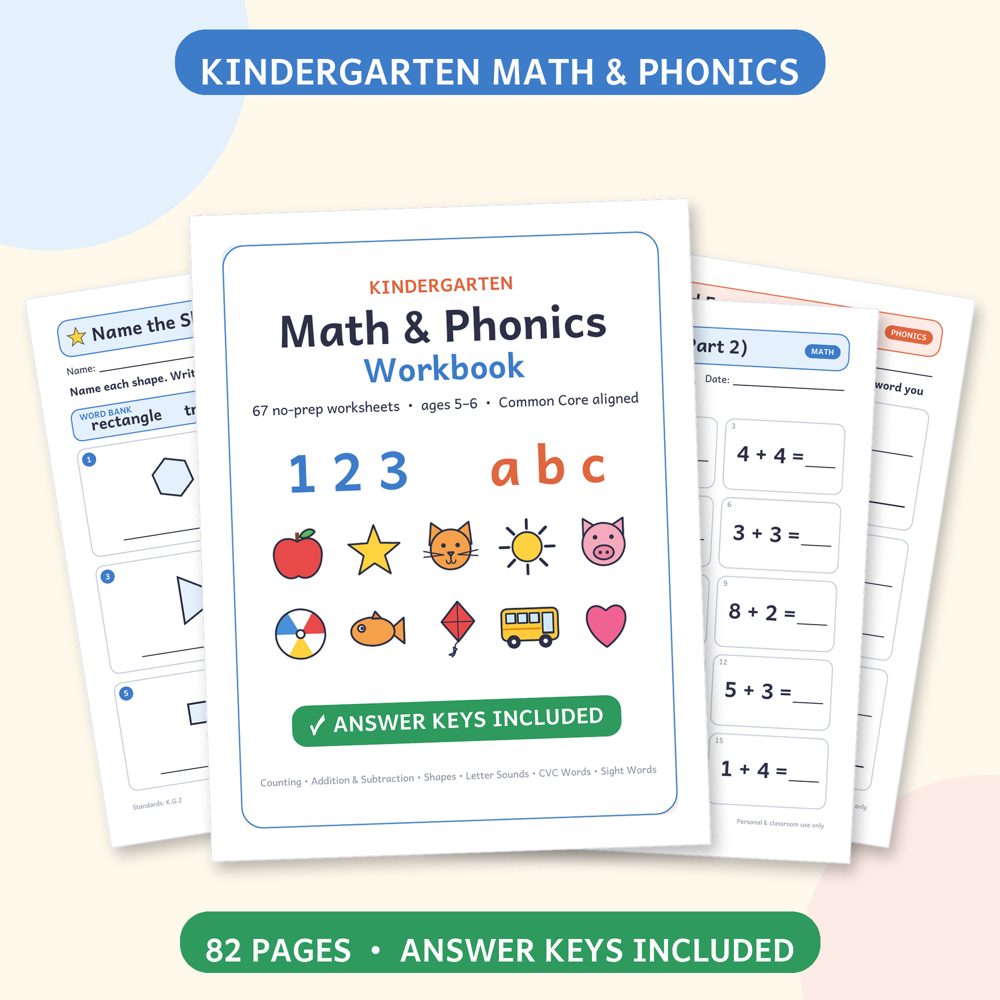
Kindergarten Math & Phonics Workbook
82 printable pages: 67 no-prep worksheets (38 math, 29 phonics) plus a 9-page answer key, aligned to Common Core Kindergarten. $7.99, instant PDF (US Letter and A4).
See what's inside Get 4 free sample pages
We make and sell this workbook, so we have a financial interest. It was made with the help of AI tools; see the product page for details.
A realistic daily routine for a child who's behind
Short and daily beats long and weekly. A 20-minute block might look like:
- 3 minutes: sound game. Rhyming, "I spy something that starts with /m/," or clapping syllables.
- 8 minutes: the program's lesson. Whatever your chosen program says for today.
- 5 minutes: practice. One worksheet page or app session on the same sound.
- 4 minutes: read together. A decodable reader, with your child reading the words they can decode and you reading the rest.
Then read aloud to them at another time of day, just for fun.
When to ask for help
Some children need more than a better program. The International Dyslexia Association recommends universal screening starting in kindergarten, looking at skills such as phonological awareness, letter-sound knowledge and rapid naming (IDA, Universal Screening: K–2 Reading). Talk to your pediatrician or ask your local school district about screening or an evaluation if:
- your child still can't hear rhymes or first sounds after several weeks of daily practice,
- letter sounds learned one week are gone the next, again and again,
- you have family history of reading difficulties, or
- there are speech, hearing or attention concerns.
Homeschooled children can often get evaluations through their public school district; rules vary by state, so check your state's homeschool law (HSLDA keeps a state-by-state map).
Bottom line
For a kindergartner who's behind, pick one systematic program you'll actually do daily, start at your child's real level (even if that's "pre-reading"), add short paper or app practice, and read together every day. If progress stalls after consistent effort, ask for a screening. That's not failure; it's information.
Prices checked October 2026. Links marked as affiliate placeholders aren't live yet.