Math
Kindergarten Math Skills Checklist: What Your Child Should Know by the End of K
This guide is for parents. It may contain affiliate links and mentions our own workbook; if you buy through them we may earn money at no extra cost to you. We have not hands-on tested the paid programs below unless we say so; we compare them from their published information. Details.
Wondering whether your kindergartner is "on track" in math? The clearest yardstick most U.S. schools use is the Common Core kindergarten math standards (many states use them directly or in adapted form). They're written for teachers, so below we translate each one into plain English, add a quick at-home check, and suggest what to practise if your child isn't there yet.
This is a guide for parents, not a diagnostic test. Children develop at different rates, and your state's standards may differ slightly. Every standard below links to its official wording.
The five areas of kindergarten math
Common Core groups kindergarten math into five domains (Common Core Kindergarten math):
- Counting & Cardinality (K.CC): counting, writing numbers, comparing.
- Operations & Algebraic Thinking (K.OA): early addition and subtraction.
- Number & Operations in Base Ten (K.NBT): teen numbers as "ten and some more."
- Measurement & Data (K.MD): comparing length and weight, sorting.
- Geometry (K.G): naming and describing shapes.
Printable-style checklist
Tick each one your child can do comfortably, on more than one day.
Counting & Cardinality (K.CC)
| ✓ | Skill | 2-minute check at home |
|---|---|---|
| ☐ | Counts to 100 by ones and by tens (K.CC.A.1) | "Count as high as you can." Then: "Count by tens: 10, 20…" |
| ☐ | Counts on from any number, not only from 1 (K.CC.A.2) | "Start at 37 and keep counting." |
| ☐ | Writes numbers 0–20 and matches a numeral to a group of objects (K.CC.A.3) | Put out 14 buttons: "Write how many." |
| ☐ | Understands the last number counted tells "how many" (K.CC.B.4) | After they count 8 spoons, ask "So how many spoons?" Do they answer without recounting? |
| ☐ | Counts up to 20 things in a line, array or circle, or up to 10 scattered (K.CC.B.5) | Scatter 10 dry pasta pieces: "How many?" |
| ☐ | Tells which group has more, less or the same (K.CC.C.6) | Two piles of 6 and 8 grapes: "Which has more?" |
| ☐ | Compares two written numbers between 1 and 10 (K.CC.C.7) | Write 7 and 4: "Which is bigger?" |
If not yet: count real things daily (stairs, snacks, toys), point to each object once, and ask "how many?" at the end. Practise writing one or two numbers a day rather than all twenty at once.
Operations & Algebraic Thinking (K.OA)
| ✓ | Skill | 2-minute check at home |
|---|---|---|
| ☐ | Shows adding and taking away with objects, fingers, drawings or acting out (K.OA.A.1) | "Show me 3 cars and 2 more cars." |
| ☐ | Solves add/subtract word problems within 10 (K.OA.A.2) | "You have 6 crackers and eat 2. How many are left?" |
| ☐ | Breaks numbers up to 10 into pairs in more than one way (K.OA.A.3) | "5 is 2 and…? What else makes 5?" |
| ☐ | Finds the number that makes 10 with any number 1–9 (K.OA.A.4) | "I have 7. How many more to make 10?" (a ten frame helps) |
| ☐ | Adds and subtracts fluently within 5 (K.OA.A.5) | Quick-fire: 2 + 3, 4 − 1, 5 − 2 |
If not yet: use counters and a ten frame (a 2×5 grid) for "make 10" games. Keep fact practice within 5 until it's quick, then move up.
Number & Operations in Base Ten (K.NBT)
| ✓ | Skill | 2-minute check at home |
|---|---|---|
| ☐ | Sees numbers 11–19 as ten ones and some more ones, e.g. 18 = 10 + 8 (K.NBT.A.1) | Fill a ten frame plus 3 loose counters: "How many? How many is ten and three?" |
If not yet: bundle 10 straws with a hair tie and add loose straws to build teen numbers.
Measurement & Data (K.MD)
| ✓ | Skill | 2-minute check at home |
|---|---|---|
| ☐ | Describes measurable attributes like length or weight (K.MD.A.1) | "What could we measure about this book?" (long, heavy…) |
| ☐ | Directly compares two objects: taller/shorter, heavier/lighter (K.MD.A.2) | "Which pencil is longer? How do you know?" |
| ☐ | Sorts objects into groups, counts each group, and orders groups by count (K.MD.B.3) | Sort a handful of LEGO by color, count each, and say which has most |
Geometry (K.G)
| ✓ | Skill | 2-minute check at home |
|---|---|---|
| ☐ | Uses position words: above, below, beside, in front of, behind, next to (K.G.A.1) | "Put the toy behind the cup." |
| ☐ | Names shapes regardless of size or turn (K.G.A.2) | Show a triangle upside down: still a triangle? |
| ☐ | Tells flat (2D) from solid (3D) shapes (K.G.A.3) | A paper circle vs a ball |
| ☐ | Compares shapes and describes sides and corners (K.G.B.4) | "How many corners does a square have?" |
| ☐ | Builds and draws shapes (K.G.B.5) | Make a triangle from three sticks |
| ☐ | Combines simple shapes into larger ones (K.G.B.6) | "Can two triangles make a rectangle?" |
How to use this checklist without stress
- Check over a few days, not in one sitting. Five-year-olds have off days.
- Don't turn it into a test. Fold the checks into play: snack time, LEGO, walks.
- Focus on 1–2 gaps at a time. Counting and early addition (K.CC and K.OA) take up most of the list; start there.
- Look for understanding, not only right answers. A child who counts on from 7 to get 7 + 2 understands more than one who recites a memorised fact.
Practice ideas that cost nothing
- Ten-frame snacks: draw a 2×5 grid and fill it with crackers. "How many? How many more to make 10?"
- Number of the day: pick a number like 8 and find ways to make it: 5 + 3, 4 + 4, 10 − 2.
- Shape hunt: find circles, rectangles and triangles around the house; talk about sides and corners.
- Sort the laundry: sort socks by color and count each pile.
When a workbook helps
Hands-on play should come first, but short paper practice is a good way to see what's sticking and to build the habit of writing numbers. Look for pages that show the standard they cover, so you know what each page is for, and an answer key so checking is quick.
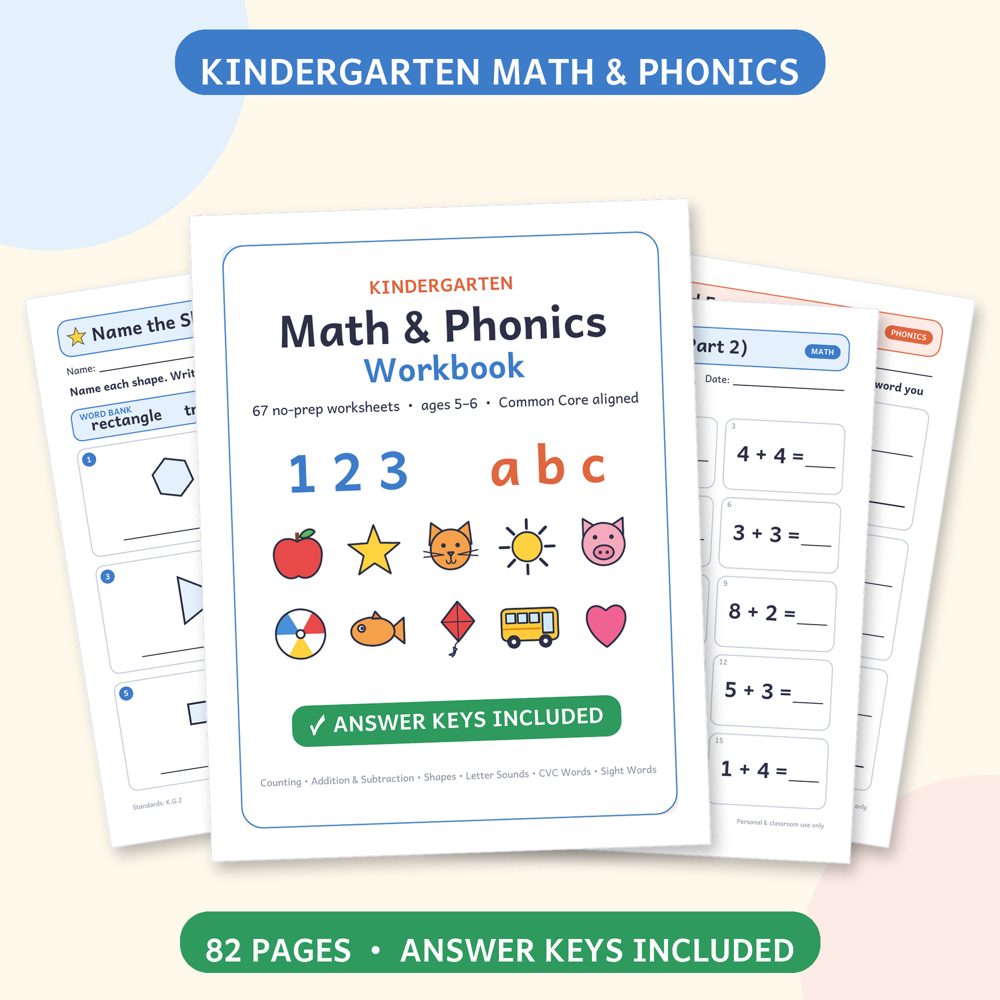
We made our own kindergarten workbook along exactly these lines: its 38 math pages cover counting and writing to 20, missing numbers to 100, counting by tens, comparing, ten frames and making 10, number bonds, addition and subtraction within 10, fact fluency within 5, word problems, teen numbers, shapes, longer/shorter and sort-and-count, each labeled with its Common Core standard.
From our own shop
Kindergarten Math & Phonics Workbook
82 printable pages: 67 no-prep worksheets (38 math, 29 phonics) plus a 9-page answer key, aligned to Common Core Kindergarten. $7.99, instant PDF (US Letter and A4).
See what's inside Get 4 free sample pages
We make and sell this workbook, so we have a financial interest. It was made with the help of AI tools; see the product page for details.
If you want to try before buying, our free sample pack includes the "Make 10" and "Addition within 10" pages.
What about first grade?
By the end of first grade, Common Core expects fluent addition and subtraction within 10 and working within 20 using strategies like making ten (Common Core 1.OA). If your kindergartner has most of this checklist down, that's the direction to head next. See printable vs app math practice for grade 1.
FAQ
My child can count to 100 but can't tell me how many are in a pile of 12. Is that normal? Yes, it's common. Reciting the count sequence (K.CC.A.1) and counting objects to answer "how many?" (K.CC.B.4 and B.5) are separate skills. Practise touching each object once as you count, and ask "so how many?" at the end.
Should my kindergartner memorise addition facts? The kindergarten standard is fluency within 5 (K.OA.A.5). Facts within 10 are a first-grade fluency goal (1.OA.C.6). Before that, understanding comes first: making 10 with a ten frame, breaking 5 into 2 and 3, and acting out story problems.
What if my state doesn't use Common Core? Most state kindergarten math standards cover similar ground (counting, comparing, early addition and subtraction, shapes), but wording and order can differ. Check your state education department's standards page if you need an exact match, for example for homeschool records.
When to ask for help
If your child struggles with most of the counting skills late in the kindergarten year, despite regular practice, mention it to their teacher or pediatrician, or ask your school district about an evaluation. Early support is easier than catching up later.
Standards quoted from the Common Core State Standards Initiative website. Check your own state's standards if they differ.