Math
Mathseeds vs IXL Math for Kindergarten: Which Is Better Value?
This guide is for parents. It may contain affiliate links and mentions our own workbook; if you buy through them we may earn money at no extra cost to you. We have not hands-on tested the paid programs below unless we say so; we compare them from their published information. Details.
If you're looking at a math app for your kindergartner, Mathseeds and IXL Math are likely on your shortlist. They solve different problems. Mathseeds is a lesson-based early math program that comes bundled with Reading Eggs. IXL Math is a very large bank of adaptive practice skills. One teaches along a path; the other lets you practise exactly the skill you pick.
We haven't used either with our own children for this comparison. It's based on each company's published information and independent price summaries, all linked below. Check current prices before subscribing.
Quick verdict
- Mathseeds is better value if you also want a reading program, have more than one young child, or want your kindergartner guided through lessons in order.
- IXL Math is better if you only want math, want to target specific skills (like "make 10" or teen numbers), or want one program that continues into later grades and other subjects.
- Neither is necessary for a kindergartner whose math happens through counting, games and short paper practice. Kindergarten math is very hands-on.
Price comparison
| Mathseeds (via Reading Eggs) | IXL Math | |
|---|---|---|
| Monthly | $13.99 (includes all Reading Eggs reading programs) | $9.95 (math only) |
| Yearly | $99.99 | $79 |
| Children covered | Up to 4 | 1, plus about $4/month or $40/year per extra child |
| Reading included? | Yes | Only with the $15.95/month or $129/year combo |
| Trial | 30-day free trial; 30-day money-back guarantee | Independent summaries mention a 30-day money-back guarantee and limited free daily practice |
Sources: Reading Eggs pricing page; IXL figures from independent summaries by Brighterly (updated Aug 24, 2026) and The Pricer (June 2026). IXL's own pricing page didn't show prices to our page fetch, so confirm at ixl.com.
What the numbers mean:
- One child, math only: IXL ($79/year) is about $21 cheaper than Reading Eggs + Mathseeds ($99.99/year).
- One child, math and reading: Reading Eggs + Mathseeds ($99.99/year) is about $29 cheaper than IXL's combo ($129/year).
- Two children, math and reading: Reading Eggs still costs $99.99/year for up to four children. IXL's combo plus one extra child would be about $169/year ($129 + $40).
What each one covers
Mathseeds
Reading Eggs describes Mathseeds as "the comprehensive early math program" for ages 3–9, with 200 interactive lessons, 280 printable worksheets and progress reports (Reading Eggs pricing page). It's lesson-based: children move through a sequence, with rewards along the way.
The company also sells printed Mathseeds workbooks for Kindergarten, Grade 1 and Grade 2 at $19.95 each, described as 250+ pages each (same page). That's a sign the program expects some paper practice alongside the app.
IXL Math
IXL's kindergarten math page lists 369 skills, 348 videos and 56 games when we checked, starting with tiny steps like "Identify numbers – up to 3" and "Count on frames – up to 5" (IXL kindergarten math). Skills are grouped by topic, and you can choose skill plans aligned to state standards.
That granularity is IXL's strength. If your child is stuck on one thing, you can find a skill for exactly that. The flip side is that a five-year-old won't navigate 369 skills alone; a parent needs to pick, or follow IXL's recommendations.
Lessons vs practice: why it matters at age 5
Kindergarten math standards ask children to understand quantities, not just answer quickly. For example: understand that the last number counted tells "how many" (K.CC.B.4), break numbers up to 10 into pairs in more than one way (K.OA.A.3), and represent addition and subtraction with objects, fingers and drawings (K.OA.A.1). Fluency is only expected within 5 (K.OA.A.5) (Common Core K.CC, K.OA).
- A lesson-based program like Mathseeds introduces ideas in order, which suits a child meeting them for the first time.
- A practice-based program like IXL works best once a child has met the idea, for example with you and some counters, and needs repetition with feedback.
The U.S. Department of Education's practice guide on math intervention recommends timed fluency activities with immediate corrective feedback on skills students have already learned, along with concrete and visual representations (IES practice guide, 2021). An app's instant feedback is useful for that practice part, not as a substitute for hands-on teaching.
Screen time
The American Academy of Pediatrics recommends that children 2 to 5 have no more than 1 hour per day of high-quality screen programming, ideally with a parent co-viewing (AAP, Media and Young Minds). If you're also using a reading app, the two share that budget. Many families run a short math app session two or three times a week, and do counting games and paper pages on the other days.
Side-by-side for a kindergartner
| Mathseeds | IXL Math | |
|---|---|---|
| Style | Guided lessons with rewards | Adaptive question practice, plus videos and games |
| Scope listed | 200 lessons, 280 printables (ages 3–9) | 369 kindergarten skills, 348 videos, 56 games |
| Parent role | Lower in-session; check reports | Choose skills or follow recommendations |
| Best for | Learning new ideas in order | Targeted practice on known skills |
| Grows with child | To about age 9 | Through high school, plus other subjects |
| Value sweet spot | Reading + math, several kids | Math only, one child |
Which should you choose?
- Your kindergartner needs both reading and math, or you have 2–4 young children: Mathseeds via Reading Eggs. One price covers everything.
- You only want math for one child, and your child already understands the basics: IXL Math.
- Your child is still learning what numbers mean: hold off on both. Spend a few weeks on counting real objects, ten frames and "how many more to make 10" games (see our ten frame activities), then add an app for practice.
How to decide in a week
If you can't choose from the descriptions, a short, structured look helps:
- Note three things your child can and can't do yet, using our kindergarten math checklist: for example "counts to 20 objects: yes; make 10: not yet; teen numbers: not yet".
- Start the Reading Eggs free trial and let your child do a few Mathseeds lessons. Watch: are they learning something new, or clicking through?
- Try IXL's free daily practice (if available) on one skill from your "not yet" list, sitting beside your child.
- Ask which one your child would choose, and which one you'd be happy to supervise for months.
- Decide before any trial ends, and set a calendar reminder so you don't auto-renew by accident.
Most families find the answer obvious after a week: a child who needs teaching gravitates to lessons; a child who needs repetition is happier with targeted practice.
A paper alternative
If you'd rather keep math mostly off screens, a short printed page a day covers much of the same ground. Look for pages labeled with the standard they practise and an answer key, so checking takes seconds. Use our kindergarten math checklist to decide what to focus on.
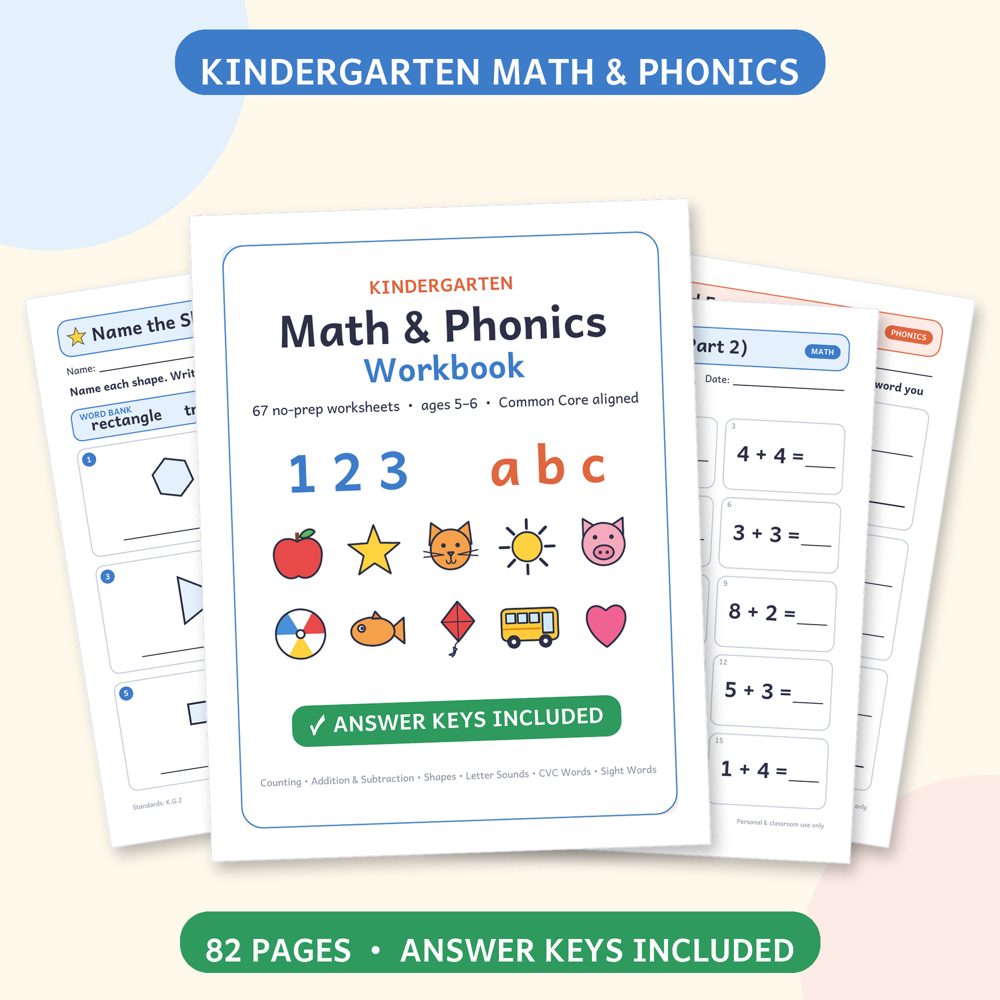
Our own kindergarten workbook takes this approach. Its 38 math pages cover counting and writing to 20, ten frames and making 10, number bonds, addition and subtraction within 10, teen numbers, shapes and measurement, each labeled with its Common Core standard.
From our own shop
Kindergarten Math & Phonics Workbook
82 printable pages: 67 no-prep worksheets (38 math, 29 phonics) plus a 9-page answer key, aligned to Common Core Kindergarten. $7.99, instant PDF (US Letter and A4).
See what's inside Get 4 free sample pages
We make and sell this workbook, so we have a financial interest. It was made with the help of AI tools; see the product page for details.
FAQ
Is Mathseeds sold separately from Reading Eggs? The home subscription on the Reading Eggs pricing page includes Mathseeds with the reading programs; we didn't find a math-only plan on that page.
Does IXL have a free option? Independent summaries say you can do a limited number of practice questions per day without a membership (Brighterly).
Which is better for first grade? Both cover first grade. IXL continues much further and adds subjects; Mathseeds is listed for ages 3–9.
Prices checked October 2026. We may earn a commission if you subscribe through affiliate links once they're active.