Math
Ten Frame Activities for Kindergarten: 12 Ideas Plus a Free Printable
This guide is for parents. It may contain affiliate links and mentions our own workbook; if you buy through them we may earn money at no extra cost to you. We have not hands-on tested the paid programs below unless we say so; we compare them from their published information. Details.
A ten frame is just a rectangle split into two rows of five boxes. It's also one of the most useful tools in kindergarten math, because it lets a child see numbers: how many, how many more to make 10, and why 13 is "ten and three". You can draw one on paper in thirty seconds, and you don't need to buy anything to use the ideas below.
This guide is for parents. Each activity notes the kindergarten standard it supports, linked to the official wording. We haven't run our own classroom trials; the ideas are standard early-math practice, linked to public standards and research guidance.
Why ten frames work
The U.S. Department of Education's practice guide on elementary math intervention recommends using concrete and visual representations, and explicitly connecting them to written numbers and equations (IES practice guide, Assisting Students Struggling with Mathematics, 2021). A ten frame is exactly that kind of representation, and it maps directly onto several kindergarten standards:
- K.CC.B.5: count to answer "how many?" for up to 20 things (Common Core K.CC).
- K.OA.A.3: break numbers up to 10 into pairs in more than one way.
- K.OA.A.4: for any number from 1 to 9, find the number that makes 10 (Common Core K.OA).
- K.NBT.A.1: see numbers 11–19 as ten ones and some more ones (Common Core K.NBT).
It also sets up first grade, where children use strategies like "making ten" to add within 20 (e.g., 8 + 6 = 8 + 2 + 4 = 10 + 4) (Common Core 1.OA.C.6).
How to make a ten frame
- Draw it: a long rectangle, split into 2 rows × 5 columns. Make each box big enough for a coin or a cracker.
- Print it: our free sample pack includes a "Make 10" page built around ten frames (free printables).
- Improvise it: an egg carton with two cups cut off, or a muffin tin with 10 cups.
Counters: buttons, dried beans, coins, cereal, mini erasers or LEGO bricks. Two colors are useful for the addition activities. If you'd rather buy a set, inexpensive plastic ten frames and two-color counters are widely sold (for example, ten frames and counters on Amazon).
One rule: always fill the top row first, left to right, then the bottom row. That consistency is what lets children "see" 7 as "5 and 2 more" without counting.
12 ten frame activities, easiest to hardest
Counting and quantity
1. Fill and count (K.CC.B.5). Your child places counters one at a time, saying each number. At the end ask "How many?" Do they answer without recounting? That shows they understand that the last number counted tells how many (K.CC.B.4).
2. Flash and say. Fill a frame with some counters, show it for two seconds, then cover it. "How many did you see?" Over time, children start seeing 5 (a full row) at a glance, and then 5-and-some-more.
3. Show me the number (K.CC.A.3). Write a number from 0 to 10 on a sticky note. Your child builds it on the frame. Then reverse: you build it, they write the number.
4. More or less? (K.CC.C.6). Two frames side by side, one with 6 counters and one with 8. "Which has more? How many more?" Ten frames make the difference visible: just look at the empty boxes.
Making 10 and breaking numbers apart
5. How many more to make 10? (K.OA.A.4). Put 7 counters on the frame. "How many empty boxes? So 7 and how many make 10?" Write it: 7 + 3 = 10. Repeat for every number from 1 to 9. This is one of the most valuable activities on the list.
6. Two-color shake (K.OA.A.3). Shake 6 two-sided counters (or coins: heads/tails) and place them on the frame. "4 red and 2 yellow make 6." Shake again: "3 and 3 make 6." Record each way. The standard asks for decomposing numbers "in more than one way", and this game does exactly that.
7. Snack subtraction (K.OA.A.2). Fill 9 boxes with crackers. Eat 3. "How many are left?" Write 9 − 3 = 6. Word problems in kindergarten stay within 10, and edible ones are memorable.
8. Ten frame war. Each player flips a card (remove face cards; ace = 1, 10 = 10) and builds the number on their frame. Bigger number wins both cards. Then try "make 10 war": whoever can say how many more make 10 first wins.
Teen numbers
9. Ten and some more (K.NBT.A.1). Use two frames. Fill the first completely (10), then put 4 on the second. "Ten and four is… fourteen." Write 14 = 10 + 4. Do this for every number from 11 to 19.
10. Build the teen. Say a teen number ("seventeen"). Your child fills one frame and puts 7 on the second. Ask: "How many full tens? How many extra ones?"
Fluency and first-grade readiness
11. Quick-look facts within 5 (K.OA.A.5). Kindergartners are expected to add and subtract fluently within 5 (K.OA). Show a frame with 3 counters, then add 2 while your child watches: "3 and 2 is…?" Keep it quick and playful, a few facts at a time. Fluency practice works best on facts that have already been understood with counters, not as a way to learn them.
12. Make ten to add (first-grade bridge). For a child ready to go beyond 10: 8 + 5. Put 8 on one frame. Move 2 of the 5 to fill it (10), and 3 are left over: 10 + 3 = 13. This is the "making ten" strategy named in the first-grade standard (1.OA.C.6).
How to fit this into a week
You don't need all twelve. A simple rotation, 5–10 minutes a day:
| Day | Activity |
|---|---|
| Mon | Fill and count, then Flash and say |
| Tue | How many more to make 10? |
| Wed | Two-color shake |
| Thu | Snack subtraction, or Ten frame war |
| Fri | Teen numbers (once 1–10 is solid) |
Once a skill is easy with counters, move it to paper: a page with drawn ten frames and an equation to write. That connects the picture to the symbols, which the IES guide recommends making explicit.
From counters to paper
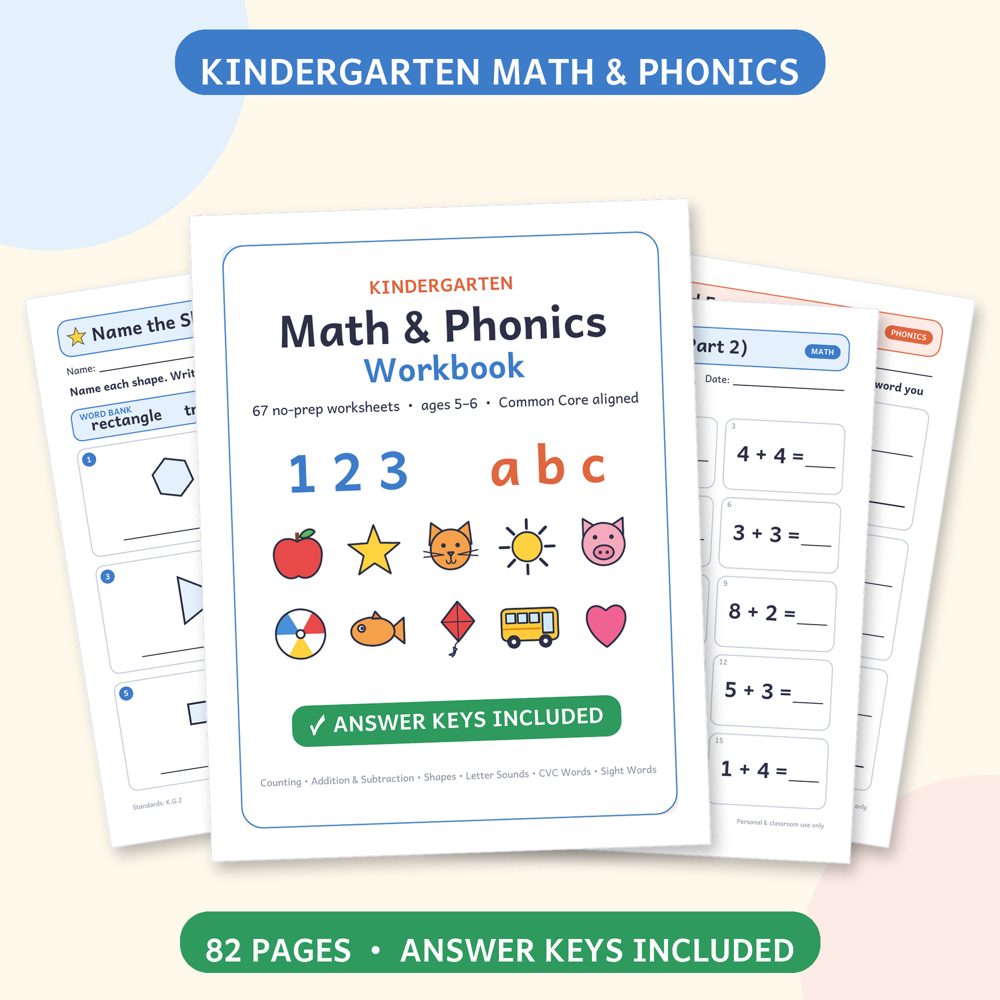
Our kindergarten workbook includes Ten Frames: How Many?, Make 10, Number Bonds to 6 and Number Bonds to 10, plus teen-number pages built on "10 and some more", each with an answer key. The Make 10 page is free in our sample pack.
From our own shop
Kindergarten Math & Phonics Workbook
82 printable pages: 67 no-prep worksheets (38 math, 29 phonics) plus a 9-page answer key, aligned to Common Core Kindergarten. $7.99, instant PDF (US Letter and A4).
See what's inside Get 4 free sample pages
We make and sell this workbook, so we have a financial interest. It was made with the help of AI tools; see the product page for details.
For a full picture of what kindergarten math covers, see our kindergarten math skills checklist. If you're weighing an app for extra practice, our Mathseeds vs IXL Math comparison covers the costs.
FAQ
What's the difference between a five frame and a ten frame? A five frame is a single row of five boxes, useful for younger children learning numbers to 5. Move to the ten frame once numbers to 5 are solid.
Should my child still count every counter? At first, yes. Over time, encourage them to see "a full row is 5" and count on from there. Seeing amounts without counting each one is the goal.
How long should we use ten frames? As long as they help. Many children use them through first grade for making-ten strategies, then naturally drop them once facts are automatic.