Math
Printable vs App Math Practice for Grade 1: What Actually Helps?
This guide is for parents. It may contain affiliate links and mentions our own workbook; if you buy through them we may earn money at no extra cost to you. We have not hands-on tested the paid programs below unless we say so; we compare them from their published information. Details.
Every parent of a first grader eventually asks: should math practice happen on paper or on a tablet? The honest answer is that the format matters less than what's being practised and how. Both can work, and each has jobs it does better.
This guide explains what first-grade math actually expects, what the research-based guides recommend for practice, where apps and printables each shine, and a simple weekly mix. We haven't run our own trials; we link to the standards, research summaries and pricing pages we used.
What first-grade math is really asking for
Under the Common Core standards (which many U.S. states use or adapt), first graders are expected to:
- Add and subtract within 20, and be fluent with addition and subtraction within 10 (1.OA.C.6).
- Use strategies, not just memory: counting on, making ten (e.g., 8 + 6 = 8 + 2 + 4 = 10 + 4), using the link between addition and subtraction (1.OA.C.6).
- Solve word problems within 20 with the unknown in any position, using objects, drawings and equations (1.OA.A.1).
- Understand the equal sign, deciding whether equations like 7 = 8 − 1 are true or false (1.OA.D.7).
Notice the mix: some of this is speed and recall (fluency within 10), and a lot is reasoning and showing (drawings, strategies, word problems). That split is the key to choosing a format.
What research-based guides recommend for practice
The U.S. Department of Education's What Works Clearinghouse practice guide on helping elementary students who struggle with math makes six recommendations: systematic instruction, clear mathematical language, visual representations, number lines, word problems, and regular timed activities to build fluency (IES practice guide, Assisting Students Struggling with Mathematics, 2021). The guide is written for intervention with students who are struggling, but its practice advice is a useful lens for any home practice:
- Fluency practice is for skills already learned. The guide recommends timed activities with immediate corrective feedback on facts a child has already been taught, not as a way to teach new ones.
- Pictures and models matter. Concrete and drawn representations (counters, ten frames, number lines) should be explicitly connected to the written equation.
- Word problems need their own practice, not just number drills.
Where apps do better
Instant feedback on fact fluency. Apps can tell a child immediately whether 7 + 3 = 10 is right, track speed, and adapt. That lines up with the "timed activities with immediate feedback" advice above, for facts your child already knows.
Motivation for some kids. Rewards and progress maps keep some children going.
Less checking for you. The app grades every answer.
Two widely used options:
| App | Math coverage for grade 1 | Price we found |
|---|---|---|
| Mathseeds (included with Reading Eggs) | Early math program for ages 3–9; 200 interactive lessons and 280 printable worksheets listed | $13.99/month or $99.99/year, includes reading programs, up to 4 children (Reading Eggs pricing) |
| IXL Math | Skill-by-skill practice by grade | $9.95/month or $79/year for one subject, per independent summaries (Brighterly; The Pricer); confirm on IXL's site |
Where printables do better
Showing thinking. Standards like 1.OA.A.1 ask children to solve problems "by using objects, drawings, and equations." A page with space to draw ten frames, number bonds or a quick picture lets your child show how they solved it, and lets you spot a wrong strategy, not just a wrong answer.
Word problems. Reading a short problem together, drawing it and writing the equation is easier on paper, at a table, with you nearby.
Screen-time budget. Pediatric guidance focuses on keeping screens from crowding out sleep, play and time with family. For children 2–5, the American Academy of Pediatrics recommends no more than 1 hour per day of high-quality screen programming (AAP, Media and Young Minds). For older children, Mayo Clinic notes that a one-size-fits-all limit doesn't work as well and families need to set their own limits (Mayo Clinic). Paper practice doesn't count against that budget.
Cost. A printable pack is a one-time purchase you can reprint for the same household; apps are subscriptions.
The trade-off: you have to check the work. That's why answer keys matter so much for busy parents.
Side-by-side
| Need | Better on paper | Better in an app |
|---|---|---|
| Learning a new strategy (making ten, counting on) | ✓ with you explaining and drawing | |
| Fluency within 10, once facts are taught | ✓ instant feedback, timing | |
| Word problems | ✓ draw, discuss, write the equation | |
| Equal sign / true-false equations | ✓ easy to discuss | ✓ quick checks |
| Independent practice while you cook | ✓ | |
| Low screen time | ✓ | |
| One-time cost | ✓ |
A simple weekly mix for grade 1
About 15–20 minutes a day, five days a week:
| Day | Main practice (paper) | Quick practice (app or flashcards) |
|---|---|---|
| Mon | New strategy page: making ten with ten frames | 5 min: facts within 5 |
| Tue | Word problems: draw and solve | 5 min: facts within 10 |
| Wed | Number bonds and fact families | 5 min: mixed facts |
| Thu | True/false equations and missing numbers | 5 min: mixed facts |
| Fri | Review page plus a math game (cards or dice) | Skip screens; play a game |
Adjust it: if your child already has facts within 10 down, move app time toward facts within 20. If they're shaky on what addition means, drop the timed practice for a while and do more drawing and counters.
Making paper practice quick (so you actually do it)
The biggest real-world problem with worksheets isn't the child; it's the parent's time. A few habits keep it to a few minutes:
- One page, not a packet. A single focused page a day is plenty in first grade. Stop while your child is still succeeding.
- Check together, immediately. Go through the answers with your child as soon as they finish, using an answer key, so mistakes get fixed while the problem is still fresh. That mirrors the "immediate corrective feedback" the IES guide recommends for fluency work.
- Circle, don't cross out. Circle anything wrong and ask "show me how you got that." Often the strategy is the issue, not the arithmetic.
- Keep a done folder. A simple folder of finished pages lets you see progress across weeks and spot facts that keep coming back wrong.
Signs the format isn't working
- App: fast tapping, guessing, or getting answers right only after several tries usually means the level is too hard or the child is chasing rewards. Turn the app off and go back to objects and drawings for that skill.
- Paper: tears, refusal, or very slow work can mean the page is too long or too hard. Cut it in half or switch to a game with dice or cards for a few days.
- Either: if your child can answer in one format but not the other (say, gets 6 + 4 right on a screen but can't show it with counters), the understanding isn't solid yet. Spend more time on the hands-on version.
If your child is still finishing kindergarten skills
Many first graders need a quick review of kindergarten foundations first: counting to 100 by ones and tens, writing numbers to 20, decomposing numbers to 10, and adding and subtracting fluently within 5 (Common Core K.CC, K.OA). Our kindergarten math skills checklist walks through each one with simple at-home checks.
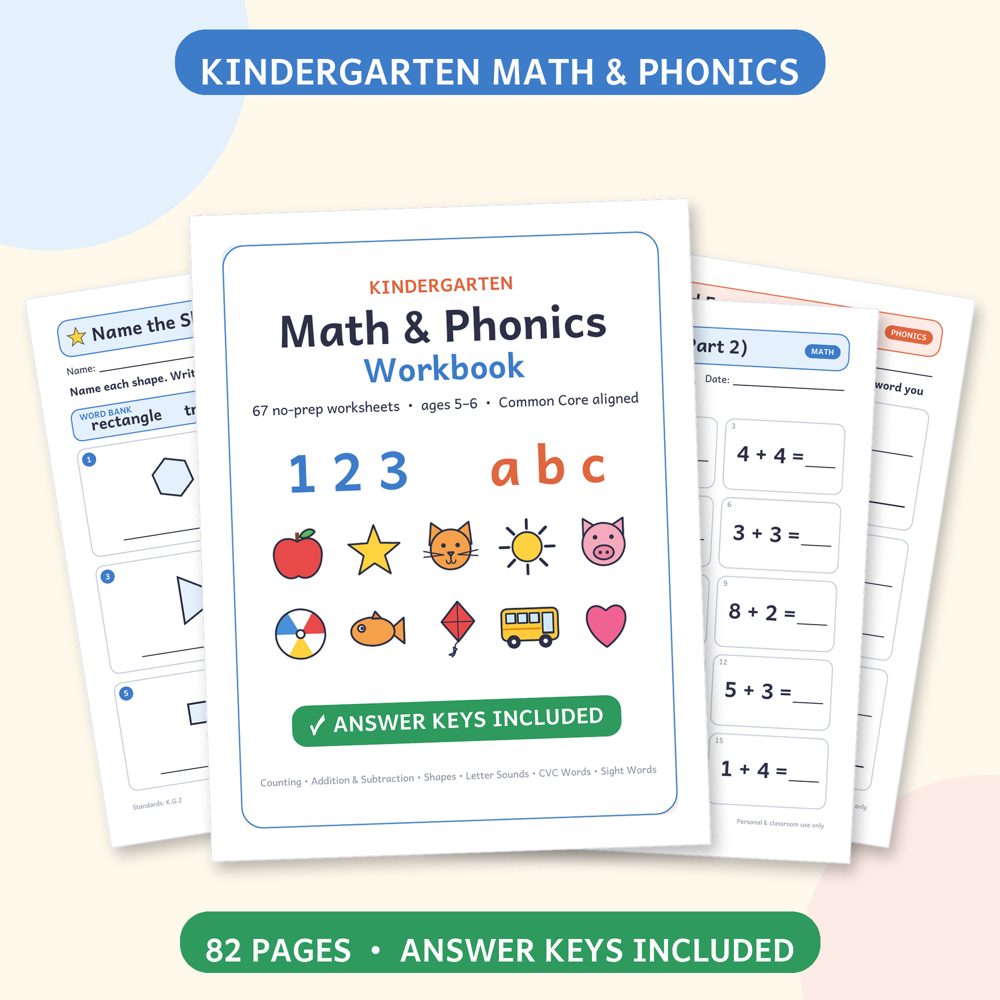
Our own kindergarten workbook ends with three challenge pages on facts within 20 for first-grade readiness, so it can also work as a review pack for a new first grader.
From our own shop
Kindergarten Math & Phonics Workbook
82 printable pages: 67 no-prep worksheets (38 math, 29 phonics) plus a 9-page answer key, aligned to Common Core Kindergarten. $7.99, instant PDF (US Letter and A4).
See what's inside Get 4 free sample pages
We make and sell this workbook, so we have a financial interest. It was made with the help of AI tools; see the product page for details.
Bottom line
Use paper to teach and show thinking: strategies, drawings, word problems. Use an app (or plain flashcards) for short, fast fluency practice on facts your child already understands. A 15-minute mix of both, most days, covers what first-grade math asks for without blowing the screen-time budget.
Prices checked October 2026. Affiliate links are placeholders until approved.