Homeschool Planning
How to Plan a Homeschool Kindergarten Week (Realistic Schedule + Free Planner)
This guide is for parents. It may contain affiliate links and mentions our own workbook; if you buy through them we may earn money at no extra cost to you. We have not hands-on tested the paid programs below unless we say so; we compare them from their published information. Details.
Homeschooling kindergarten can feel like it should look like school: a desk, a timetable, six subjects. In practice, a strong kindergarten week at home is short, predictable and heavy on reading and talking. This guide shows how to build one, with a sample week, a free one-page planner, and the legal basics to check first.
Some context: the National Home Education Research Institute estimates about 3.4 million homeschool students in the U.S. in 2024–2025 (NHERI), and Johns Hopkins' Homeschool Hub found growth continued in most reporting states in 2025–26, though more slowly (JHU Homeschool Hub). You're far from alone.
Step 1: Check your state's rules first
Homeschool requirements are set by states, and they range widely. HSLDA's state map groups states from "no notice" to "high regulation" (for example, requiring test scores, professional evaluations or curriculum approval), and advises following the law of the state you're physically living in (HSLDA, Homeschool Laws by State).
Kindergarten itself is not compulsory everywhere. A 2023 Education Commission of the States review found that at least 17 states plus the District of Columbia require kindergarten attendance (ECS, State K-3 Policies 2023). Even if your state doesn't require kindergarten, a light structure now makes first grade easier.
Before you plan, find out: Do you need to notify your district? At what age does compulsory attendance start in your state? Are certain subjects, records or assessments required? Your state's page on the HSLDA map is a good starting point. This guide isn't legal advice.
Step 2: Decide what goes in the week
For a 5-year-old, three things carry most of the weight.
1. Phonics and early reading (daily)
The U.S. Department of Education's K–3 reading practice guide recommends teaching the sounds in spoken words and how they link to letters, teaching children to decode and write words, and having each student read connected text every day (IES practice guide, Foundational Skills K–3). At home that means a short phonics lesson, a little practice, and reading together every day.
If you haven't chosen a program yet, see how to pick a phonics program for a kindergartner who's behind. It's useful even if your child isn't behind.
2. Math (most days)
Kindergarten math centers on counting, comparing, and adding and subtracting within 10, with fluency within 5 (Common Core K.CC, K.OA). Our kindergarten math checklist lists every skill with a quick at-home check.
3. Read-alouds, play and the world outside
Read aloud from books above your child's reading level. Build, draw, cook, play outside, and talk a lot. Science and social studies at this age can be library books, nature walks and questions.
Step 3: Keep lessons short
There's no single right number of minutes, and state rules about instructional time vary (check yours). Lessons for a 5-year-old work best short and focused. A practical starting point many families use is about 15–20 minutes for phonics and 10–15 minutes for math, with breaks, then adjust to your child's attention. Stop while it's still going well.
Watch screen time if you use apps: the American Academy of Pediatrics recommends no more than 1 hour per day of high-quality screen programming for children 2 to 5 (AAP, Media and Young Minds), so learning apps and shows share that budget.
A sample homeschool kindergarten week
This assumes a 4-day "table time" week with Friday for review and outings. Most of the formal work happens in the morning, about 45–60 minutes in total including breaks.
| Monday | Tuesday | Wednesday | Thursday | Friday | |
|---|---|---|---|---|---|
| Warm-up (5 min) | Calendar + count the days | Rhyming game | "I spy" first sounds | Count by tens | Song or chant |
| Phonics (15–20 min) | New sound/lesson | Practise + 1 worksheet | New sound/lesson | Practise + decodable reader | Review page or app |
| Math (10–15 min) | Counting & writing numbers | Ten frames / make 10 | Adding with objects | Shapes or measuring | Math game (dice, cards) |
| Read-aloud (15+ min) | Picture book | Picture book | Nonfiction | Poetry | Library trip |
| Hands-on / outside | Art | Nature walk | Cooking (measuring) | Building | Field trip / playdate |
Why it works:
- Phonics and math happen most days in short blocks, which suits a 5-year-old's attention.
- New material comes on Monday and Wednesday, with practice the day after.
- Friday is light: review and fun, so missed days have somewhere to go.
What one morning can look like
Here's how Tuesday from the table above might actually run, start to finish:
- 9:00 Rhyming game in the kitchen while breakfast is cleared (5 minutes).
- 9:05 Phonics at the table: review yesterday's new sound with flashcards, then one worksheet page on it. Check it together right away.
- 9:25 Movement break: jumping jacks while counting by tens, or a run around the yard.
- 9:35 Math: ten frames with crackers ("how many more to make 10?"), then eat the crackers.
- 9:50 Read-aloud on the couch: a picture book of the child's choice, then one you picked.
- 10:10 Done with table time. The rest of the day is play, errands, outside time and life, which at five is learning too.
Some days it'll take half that time, some days twice as long, and some days it won't happen. That's normal. Look at the week as a whole, not any single day.
Step 4: Use a one-page planner
You don't need a complicated planner. One page per week, with a row per area and a box to tick, is enough to see at a glance what's done and what to repeat. We made a free one for this guide.
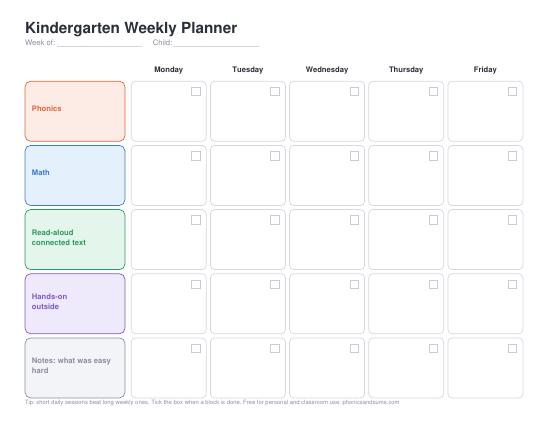
Download the free weekly planner (PDF)
How to fill it in on Sunday (10 minutes):
- Write the phonics lesson numbers or sounds for the week.
- Pick the math focus (one or two skills from the checklist).
- Choose 3–5 read-alouds.
- Note one outing or hands-on project.
- During the week, tick boxes and jot what was easy or hard in the Notes row. That's your planning for next week.
Step 5: Gather a few materials
- A phonics program or sequence. See our phonics program guide. If you'd rather use an app for part of it, compare Reading Eggs vs IXL.
- Math manipulatives: counters (buttons work), a printed ten frame, dice and a deck of cards. If you want to buy a set, math counters and ten frames on Amazon are inexpensive.
- Library card for read-alouds and decodable readers.
- Printable practice pages for the "practise" days, ideally with an answer key so checking takes seconds.
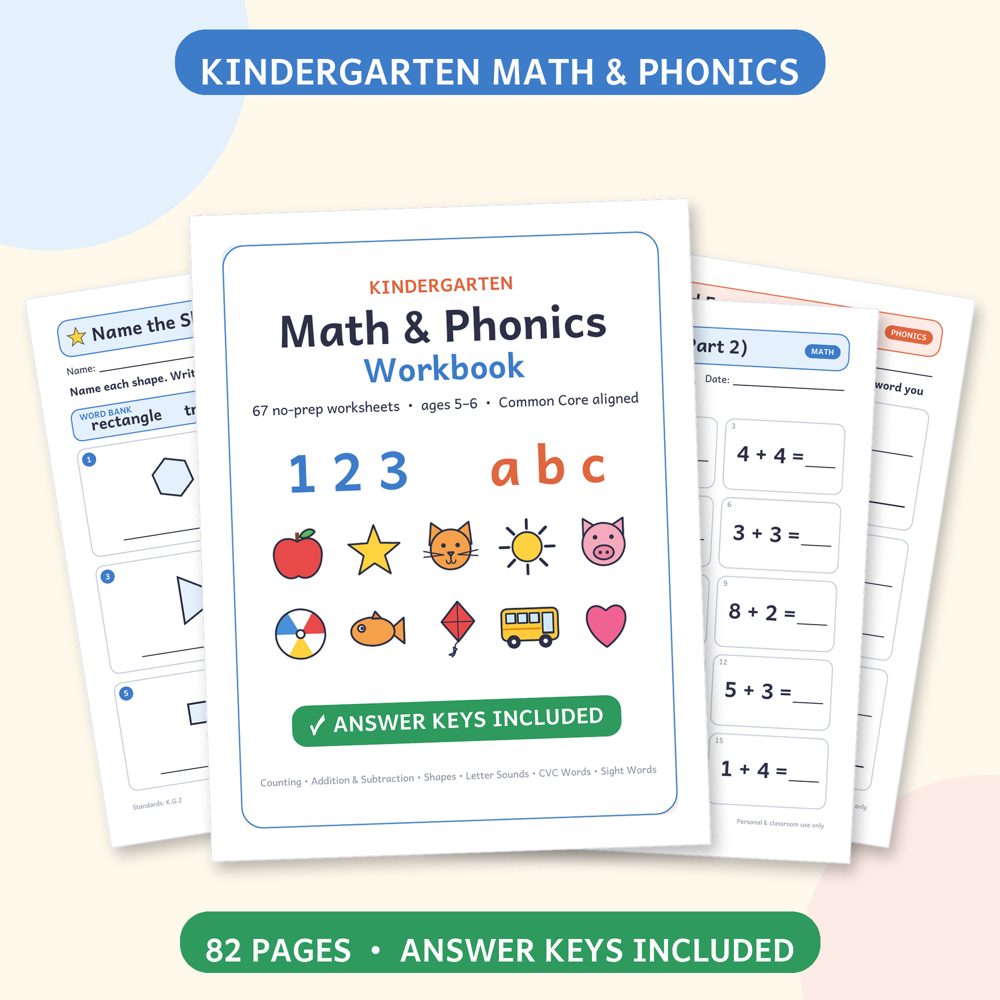
From our own shop
Kindergarten Math & Phonics Workbook
82 printable pages: 67 no-prep worksheets (38 math, 29 phonics) plus a 9-page answer key, aligned to Common Core Kindergarten. $7.99, instant PDF (US Letter and A4).
See what's inside Get 4 free sample pages
We make and sell this workbook, so we have a financial interest. It was made with the help of AI tools; see the product page for details.
Keeping records
Even if your state doesn't require much, keep a simple folder: the weekly planners, one or two work samples a month, and a list of books read. It takes minutes, and it helps if you ever need to show progress, change states, or enroll in school later. Check your state's specific record-keeping rules on the HSLDA map.
Common pitfalls
- Over-scheduling. If every day has six subjects, you'll burn out by November. Protect phonics, math and read-alouds; let everything else be flexible.
- Comparing with school hours. Schools spend time on transitions and group management that one-on-one teaching doesn't need.
- Skipping review. Short daily review of old sounds and facts is where much of the progress happens.
- Ignoring warning signs. If your child isn't making progress in letter sounds or counting after consistent practice, talk to your pediatrician or ask your school district about screening.
Bottom line
Check your state's rules, then plan a week built on short daily phonics, most-days math, and lots of reading aloud and play. Use one page to plan and track it. Adjust every Sunday based on what your child actually did, not what the plan said.
This article is general information, not legal advice. Links to affiliate programs are placeholders until approved.